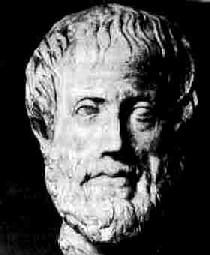
Aristotle (384-322 BCE) was a Greek philosopher and polymath who made significant contributions to various fields, including logic, metaphysics, ethics, politics, and natural sciences. Born in Stagira, Macedonia, he was a student of Plato and later founded his own school, the Lyceum. Aristotle's works cover a wide range of topics, from the nature of knowledge and reality to the principles of ethics and politics.
His philosophy is characterized by a focus on reason, logic, and empirical observation, rather than emotion or tradition. Aristotle believed in the importance of education and the role of the mind in human progress. He also developed a system of logic that laid the foundation for modern scientific methods.
His writings, including "Metaphysics," "Nicomachean Ethics," and "Politics," continue to be studied and debated by philosophers and scholars today. Aristotle's ideas have had a lasting impact on Western philosophy and have shaped the development of many modern disciplines, including psychology, ethics, and political theory.

Poetics (350 BC). Poetics is Aristotle's systematic analysis of poetry, drama and literary theory, written around 335 BC. In this influential work, Aristotle examines the elements of tragedy and other forms of poetry, establishing foundational concepts like mimesis, catharsis and the three unities that shaped Western literature for centuries.
Rhetoric (350 BC). Aristotle's Rhetoric is one of the earliest systematic treatments of the art of persuasive speaking and writing, examining the techniques of argumentation, emotion, and character that speakers can use to influence their audiences. Written in the 4th century BC, this foundational text explores the three modes of persuasion - logos (logic), pathos (emotion), and ethos (character) - and continues to be highly influential in fields ranging from public speaking to literary criticism.
Categories (350 BC). Categories is one of Aristotle's foundational works on logic, written around 350 BC, which explores how things can be classified and described. In this influential text, Aristotle examines fundamental concepts like substance, quantity, and relation while establishing a framework for understanding the basic building blocks of reality.
On Interpretation (350 BC). On Interpretation is Aristotle's analysis of language and logic, examining how meaning is created through the relationship between spoken words, written words, thoughts and reality.
Prior Analytics (350 BC). Prior Analytics is Aristotle's systematic analysis of logical arguments, introducing syllogistic reasoning and establishing the foundations for deductive logic.
Posterior Analytics (350 BC). Posterior Analytics is Aristotle's analysis of logic, examining the relationship between language and reality, and how to use language to understand and reason about the world.
Topics (350 BC). Topics is Aristotle's treatise on dialectical reasoning, providing methods for constructing arguments and engaging in debate using commonly accepted opinions.
Metaphysics (350 BC). Metaphysics is Aristotle's profound investigation into the nature of reality, existence, causation, form and matter, and the prime unmoved mover.
On Dreams (350 BC). In this philosophical treatise, Aristotle explores the nature of dreams and their relationship to perception and thought, examining whether dreams arise from our faculty of intelligence or sense-perception.
Copyright 1995-2024, Jawaid Bazyar
Comments and suggestions to info@libertyonline.info